
Custom Aluminum Gantry Crane for NextEra Energy – Twin Rivers, Wisconsin
In July 2018, we received another custom crane request related to NextEra Energy, this time from its Twin Rivers, Wisconsin facility, through Day & Zimmerman Company. The project required a unique aluminum gantry crane that incorporated several specialized features beyond a standard design.
Project Requirements
The customer’s primary requirements included:
- Lightweight aluminum gantry construction
- The ability to roll easily while carrying a full 6,000-pound load
- Height adjustment while supporting the full rated load
- Smooth movement of the load from one side of the I-beam to the other
- A custom I-beam length to meet the facility’s exact specifications
Fortunately, we had previously designed and manufactured a similar crane for another customer. While the dimensions and specifications were different, the previous project provided a solid engineering foundation that allowed us to efficiently adapt the design to meet these new requirements.
Lightweight Design
The choice of aluminum construction was essential to minimizing the overall weight of the crane while maintaining the required structural capacity. Aluminum also made the crane easier to transport and position within the facility.
Easy Rolling While Fully Loaded
Our aluminum gantry cranes have always been capable of rolling under load. However, this customer emphasized that the crane needed to roll as easily as possible while supporting its full 6,000-pound capacity.
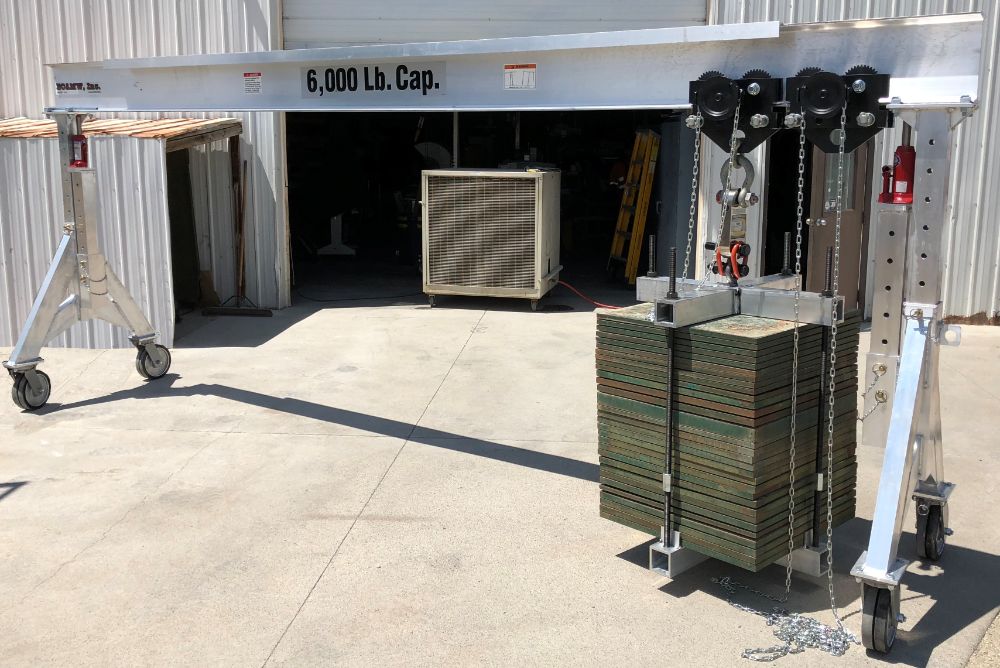
To exceed this requirement, we upgraded well beyond standard casters and equipped the crane with Hamilton Caster Company’s 4,000-pound-rated Swivel-EAZE® casters. While this exceeded the required capacity, the investment proved worthwhile. During testing, the crane rolled exceptionally smoothly under full load, as demonstrated in the accompanying photograph.
Height Adjustment Under Load
Adjusting the crane’s height while carrying a 6,000-pound load presented a greater engineering challenge. Because we had successfully incorporated this feature into an earlier design, adapting it to this project was straightforward.
The system utilized two commercial-grade bottle jacks integrated into the bases of the crane, working in conjunction with dual vertical support columns on each side. This configuration allowed the crane height to be safely adjusted while remaining fully loaded.
Controlled Trolley Movement
Another customer requirement was the ability to move the suspended load smoothly from one side of the I-beam to the other. Achieving this required careful attention to both the structural design and the trolley selection.
One engineering challenge was preventing unintended trolley movement if the crane became slightly out of level. Since the crane was designed to allow height adjustment while supporting a full load, maintaining perfect levelness at all times was not practical.
Under these conditions, a standard push trolley could roll freely toward the lower end of the beam, creating a serious safety hazard by potentially pinning someone between the gantry leg and the load.
To eliminate this possibility, we equipped the crane with geared trolleys. The trolleys were operated by personnel at all times, ensuring the suspended load remained under complete control throughout operation. This combination of geared trolleys and continuous operator control prevented unintended movement while allowing the load to be positioned accurately anywhere along the I-beam.
Custom Dimensions
The customer also specified an exact I-beam length of 18 feet, 1-5/8 inches, along with a maximum clear height under the beam of 75 inches. These custom dimensions were easily incorporated into the final design, ensuring the crane fit precisely within the intended workspace.
Project Summary
This project is an excellent example of how proven engineering, combined with thoughtful customization and premium components, can produce a specialized lifting solution that meets demanding operational requirements without compromising safety or performance.
Buy a Custom Gantry Crane
Want an aluminum gantry crane like this one or have one custom-built for your project? Contact us for a quote.

