
Roof Top Crane - Chimney Asbestos Removal
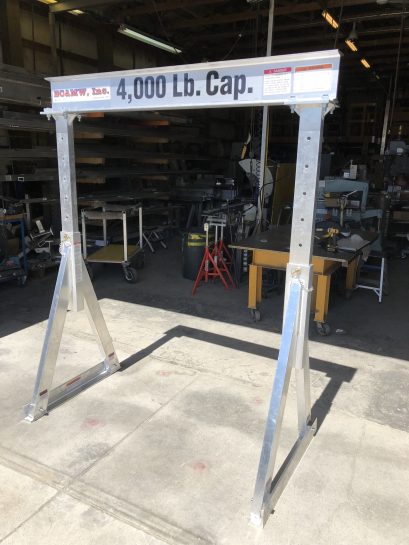
This 4,000-pound-capacity aluminum gantry crane may not be portable when it comes to rolling it around, but it was designed to solve one of the most unique lifting challenges we’ve ever encountered.
The customer specializes in removing asbestos liners from chimneys in buildings dating from the late 1800s through the 1970s. These structures range from single-story homes to six-story apartment buildings, factories, and commercial properties. Because the liners must be extracted from the top of the chimney, a lifting system capable of handling substantial loads at significant heights was required.
Project Requirements
The customer needed a custom lifting system that could:
- Safely lift up to 4,000 pounds.
- Be transported to and assembled on rooftops.
- Be installed directly on top of masonry chimneys.
- Provide a secure anchoring method for repeated use.
- Support the controlled removal of asbestos chimney liners from buildings up to six stories tall.
Custom Lifting Solution
The process begins by assembling the gantry crane on the building’s roof before manually lifting it onto the top of the brick chimney structure. In some cases, the crane is assembled directly on the chimney itself. This requirement made aluminum construction essential, providing the necessary strength while keeping the weight manageable for installation.
A unique feature of this A-frame gantry type is the replaceable aluminum angle brackets attached to each leg. During installation, the customer drills through these brackets and into the brick chimney, securing the crane with concrete anchors. Because repeated drilling eventually wears the brackets, they were intentionally designed as replaceable components. Rather than replacing an entire leg or structural member, only the angle brackets need to be changed, reducing maintenance costs while preserving the crane’s structural integrity.
Once secured, the crane works in conjunction with four chain hoists. Two hoists are attached to the top of the asbestos liner, allowing sections of the liner—sometimes extending five or six stories—to be lifted upward. The remaining two hoists are then attached below the first set, the exposed section of liner is cut away, and the process is repeated until the entire liner has been safely removed.
Why Four Chain Hoists?
Using four chain hoists allows crews to remove the liner in controlled stages instead of attempting to extract the entire section at once.
- Lift a section of the liner.
- Secure the suspended load.
- Cut away the exposed section.
- Reattach the lower hoists.
- Repeat the process until the liner is fully removed.
This incremental approach provides several important advantages:
- Better load control.
- Reduced risk of dropping material.
- Less stress on the crane.
- Safer handling of asbestos-containing components.
Although slower than traditional demolition methods, the process prioritizes worker safety and environmental containment.
The Engineering Challenge
What makes this project remarkable isn’t simply the crane itself—it’s how the entire lifting solution was engineered around a highly specialized remediation process.
Unlike traditional gantry cranes designed for warehouses, fabrication shops, or industrial facilities, this crane had to be transported to a rooftop, carried by workers, and installed on top of a narrow masonry chimney several stories above ground.
This created several unique engineering requirements:
- High lifting capacity with minimal self-weight.
- Manual assembly without heavy equipment.
- Stability on narrow brick structures.
- Resistance to repeated installation and removal.
- Reliable performance at significant heights.
Aluminum proved to be the ideal material by providing the strength, corrosion resistance, and portability required for this demanding application.
Historic Preservation Benefits
Many of the buildings serviced by this crane date from the late 1800s through the mid-1900s. Rather than demolishing these historic structures, contractors can remove the hazardous asbestos liner vertically while preserving the original chimney.
This method helps:
- Preserve historic masonry chimneys.
- Reduce demolition costs.
- Maintain original architectural features.
- Generate less contaminated waste.
For renovation projects involving historic buildings, this approach provides both environmental and structural benefits while minimizing disruption to the surrounding structure.
Project Summary
This project demonstrates how custom lifting equipment often evolves from solving unique field challenges rather than simply increasing lifting capacity. EC&MW engineered a crane that could be carried onto rooftops, securely anchored to masonry chimneys, repeatedly installed and removed, and safely extract hazardous materials from structures that are more than a century old.
It is an excellent example of EC&MW’s ability to develop specialized aluminum gantry crane solutions where conventional lifting equipment simply cannot meet the application’s requirements.
Buy a Custom Gantry Crane
Want an aluminum gantry crane like this one or have one custom-built for your project? Contact us for a quote.

